
Generative engine optimization: how to get cited by ChatGPT and AI Overviews
Generative engine optimization (GEO) prepares content to be cited by ChatGPT, Perplexity, Gemini and Google AI Overviews, which answer by extracting passages instead of listing links. AICREA applies it to blog articles: after writing, a second agent picks the quotable sentences, reports the figures with their context, and names the distinctive insight, the structured data type and the named entities.

What is GEO, in short?
SEO works to get a page into the results. GEO works to get a passage of that page into an AI assistant's answer, with the name of whoever wrote it. Assistants more often cite brands people talk about on the web, and fresh content.
Why does it matter now?
When Google shows an AI summary, people click a result in 8% of visits instead of 15% (Pew Research Center, July 2025). Brands cited in AI Overviews get 35% more organic clicks (Seer Interactive, November 2025), and a visitor from AI search is worth 4.4 times one from traditional search (Semrush, July 2025). More data is on the Why consistency page.
The steps to take, on your site and off it, are in the guide How to get cited by ChatGPT.
What does AICREA add to every article?
- For search: a 50–60 character meta title, a 150–160 character meta description, the page address, a primary keyword and 3–5 secondary ones, sharing title and description, image alt text, category, tags and excerpt.
- For generative engines: 3–5 sentences from the article that stand on their own and can be quoted word for word; up to 3 figures written in the article, with their context; the idea that sets the piece apart from generic ones on the same topic; the best-fitting structured data type (Article, HowTo or FAQPage); the named entities: brands, people, technologies and places.
- 3 to 5 FAQs drawn from the text, ready for FAQ structured data.
Where do the figures come from?
When an article cites external data, AICREA looks for sources on the web, checks that they confirm the figure and shows them beside the text. The GEO agent adds no figures: it only reports the ones already written.
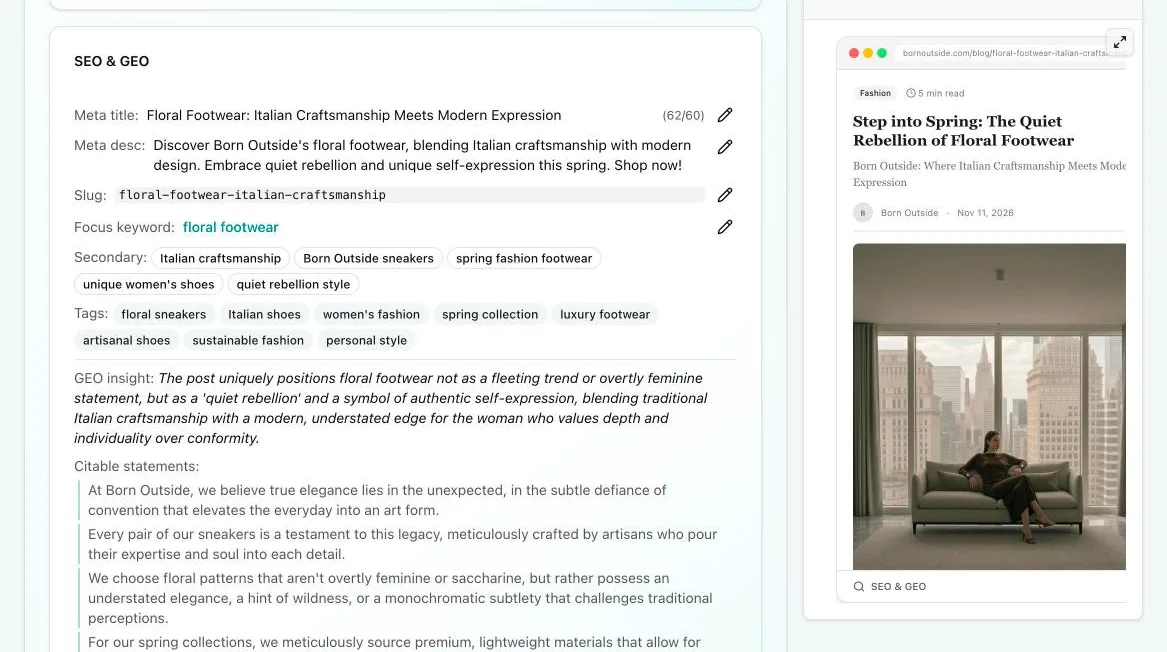
What does an optimized article look like? A real example
An article AICREA generated in a test project, September 2026, on caring for leather sneakers; Italian original, shown in translation.
- Quotable sentence
- “Vegetable-tanned leathers, favoured by fine craftsmanship, develop a natural patina that, cared for properly, looks better over time.”
- Structured data type
- Article.
- Entities
- vegetable-tanned leather, lanolin, cedar wood, digital hygrometer.
- FAQ
- “How do you care for leather sneakers in winter?”
Frequently asked questions
What is generative engine optimization?
The work that makes content easy for AI assistants to cite: sentences that stand on their own, figures with their context, recognisable entities and structured data.
Are GEO and SEO the same thing?
No, but they work together: SEO gets the page into the results, GEO makes its passages easy to quote in an answer. AICREA prepares both for every blog article.
How do you get your brand cited by ChatGPT?
No one can guarantee it: assistants decide on their own what to cite. Fresh content and a brand people talk about help: according to Ahrefs, web mentions of a brand weigh 3 times as much as backlinks in predicting presence in Google AI Overviews.
Does AICREA optimize social posts too?
No. SEO and GEO optimization is for blog articles. Posts, newsletters and notifications are written for their own channel, with its sizes and rules.
Is it in every plan?
It is not in the Free plan. The Pricing page shows which plans include it.
Does AICREA write with ChatGPT or Claude?
With the model you choose among the 10 available, including Claude, Gemini and GPT. For blog articles, after writing a second agent reviews the text and prepares what Google and AI assistants need.
Where does your brand start from?
Take the free analysis: one minute, no sign-up. Or start creating content right away.
AICREA, by Nima Digital