
How often to post on social media: what the 2025–2026 data says
Posting regularly matters more than any single post: accounts that post in at least 20 of 26 weeks get more than 5 times the engagement per post of sporadic posters. On Instagram, going from 1–2 to 6–9 posts a week brings 3.7 times the follower growth. Volume alone is not enough, though: on TikTok, published videos grew 72% while views fell 31%.
What the 2025–2026 data says
Consistency and quality: why they decide how a brand grows
Posting every week multiplies what each post earns, and original content is what Google and AI assistants choose to show. Research on millions of posts and searches, published in 2025 and 2026, says so.
What does a steady social media presence bring?
A steady presence makes social media the place where people discover a brand and decide to buy. Half of adult social media users go there to learn about brands, and brands that don't reply lose customers to competitors.

Who uses social media to learn about brands
How much does posting often and regularly matter?
More than any single post. Accounts that post in at least 20 of 26 weeks get more than 5 times the engagement per post of sporadic posters, and every week without a post slows follower growth.
Brands post 5 times a week on average on Instagram and TikTok. (Socialinsider, )

Six months of posting, two rhythms
Sporadic · 4 of 26 weeks
1×
engagement per post
Consistent · 20 of 26 weeks
5×
engagement per post
5×
the engagement per post for accounts posting in 20 or more of 26 weeks, compared with 4 or fewer.
3.7×
the Instagram follower growth with 6–9 posts a week instead of 1–2. Each post also reaches 18% more people.
+79%
average Instagram growth for accounts posting 10 or more times a week, against +19% with 2–3 posts.
17,000
more impressions per LinkedIn post when posting 11 or more times a week instead of once.
Volume alone is not enough.
On TikTok, from 2025 to 2026, published videos grew 72% while views fell 31%. Frequency pays off when every piece holds up. (Metricool, )
How many posts a week on each channel?
The most recent studies measure Instagram, LinkedIn and TikTok; we found no data of the same quality for YouTube, so we leave it out.
| Channel | What the data says | Source |
|---|---|---|
| With 6–9 posts a week, followers grow 3.7 times faster than with 1–2, and each post reaches 18% more people. | Buffer, August 2025 (2.1 million posts) | |
| With 10 or more posts a week, average growth is 79%, against 19% with 2–3 posts. | Metricool & HypeAuditor, October 2025 (700 million posts) | |
| With 11 or more posts a week, each post gets 17,000 more impressions than with one post a week. | Buffer, August 2025 (2 million+ posts) | |
| Instagram and TikTok | Brands post 5 times a week on average. | Socialinsider, January 2026 |
| TikTok | From 2025 to 2026, published videos grew 72% and views fell 31%. | Metricool, May 2026 |
These numbers don't give one right frequency for everyone. They show that regularity matters more than volume, and that volume pays off only when every piece holds up.
For Instagram, the full data and the minimum to keep are in the guide How often to post on Instagram.
Why does quality matter for Google, AI assistants and people?
Because the answer now comes before the click. When Google shows an AI summary, people click about half as often, and the brands cited in the answer win. Google asks for original content; AI assistants cite brands people talk about and fresh content.

Clicks on Google results
15% → 8%
the share of visits with a click on a result when Google shows an AI summary.
3×
the weight of web mentions of a brand compared with backlinks in predicting presence in AI Overviews (correlation 0.664 against 0.218).
25.7%
how much fresher the content AI assistants cite is than organic results.
66%
of consumers are more selective about content than a year ago. 83% see low-quality AI content on social.
“Focus on making unique, non-commodity content that visitors from Search and your own readers will find helpful and satisfying.”
Google Search Central, Top ways to ensure your content performs well in Google's AI experiences on Search, · original wording
AI itself is not the problem: across 600,000 pages Ahrefs finds no link between AI use and rankings, and in the top 20 results 81.9% of pages combine AI and human work. What counts is how useful and original the content is. (Ahrefs, )
How AICREA keeps you consistent and relevant
Consistency without the effort
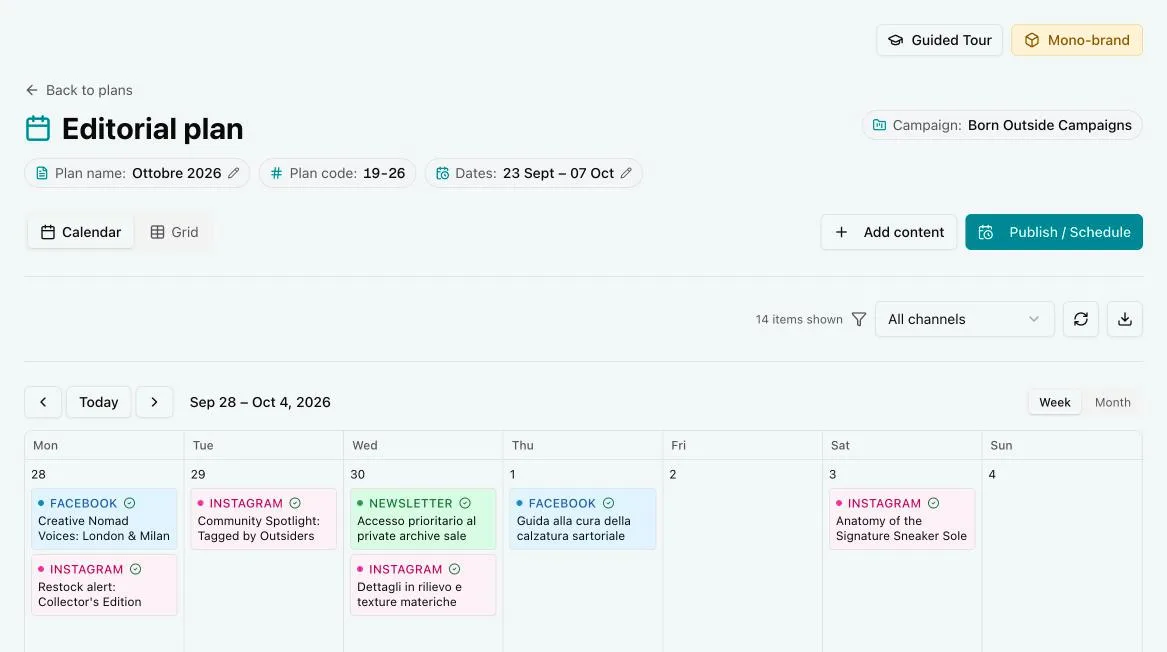
The editorial plan covers months and channels at once: the cadence is set in advance, not left to spare time.
Quality in your voice
Every piece starts from the brand identity and is approved by a person before it goes out.
Ready for Google and AI
In blog articles: quotable statements, data with context, entities and schema.org: what it takes to be picked in the answers.
Sources (17)
- Buffer, Does Posting Consistently on Social Media Matter?,
- Buffer, How Often Should You Post on Instagram?,
- Buffer, How Often Should You Post on LinkedIn?,
- Metricool & HypeAuditor, 2025 Instagram Content Playbook,
- Metricool, 2026 TikTok Study,
- Socialinsider, Social Media Benchmarks,
- Sprout Social, The 2025 Sprout Social Index,
- Sprout Social, Pulse Survey Q1 2026,
- DataReportal, Digital 2025: Global Overview Report,
- TikTok for Business, TikTok Search Ads,
- Pew Research Center, Google users are less likely to click on links when an AI summary appears in the results,
- Seer Interactive, AIO Impact on Google CTR: September 2025 Update,
- Ahrefs, An Analysis of AI Overview Brand Visibility Factors,
- Ahrefs, AI Assistants Prefer to Cite 'Fresher' Content,
- Ahrefs, AI-Generated Content Does Not Hurt Your Google Rankings,
- Semrush, We Studied the Impact of AI Search on SEO Traffic,
- Google Search Central, Top ways to ensure your content performs well in Google's AI experiences on Search,
Data checked against the original sources in October 2026. Rechecked every six months.
Frequently asked questions
How often should you post on Instagram to grow?
The largest studies favour several posts a week: with 6–9, followers grow 3.7 times faster than with 1–2 (Buffer, 2.1 million posts); with 10 or more, average growth is 79% (Metricool and HypeAuditor, 700 million posts). Brands post 5 times a week on average.
How often should you post on LinkedIn?
According to Buffer, across 2 million+ posts, accounts posting 11 or more times a week get 17,000 more impressions per post than those posting once.
Does posting more always mean growing more?
No. On TikTok, from 2025 to 2026, published videos grew 72% while views fell 31% (Metricool, 2026). 66% of consumers are now more selective about the content they watch (Sprout Social, 2026).
Does Google penalise AI-written content?
Not when it is useful. Across 600,000 pages Ahrefs finds no link between AI use and rankings, and in the top 20 results 81.9% of pages combine AI and human work. Google asks for unique, non-commodity content.
How often do you update this data?
Every six months we check each figure against its original source and replace the ones that are out of date. The last check was in October 2026.
Does your brand post consistently?
Find out in a minute with the free analysis, or start right away with your editorial plan.
AICREA, by Nima Digital